Facebook Marketplace · Brisbane QLD · seller's title says "VTX"

1983 Honda
VT250F
Integra

There is no 1983 Honda VTX. The VTX badge didn't exist until the VTX1800 in 2001 — what's actually listed is a VT250F2 Integra: Honda's 90° V-twin screamer with the inboard front disc and the red zone starting at 12,500 rpm.

AU$2,200 248 cc V-twin 6-speed Listing says 1,234 km — ignore it
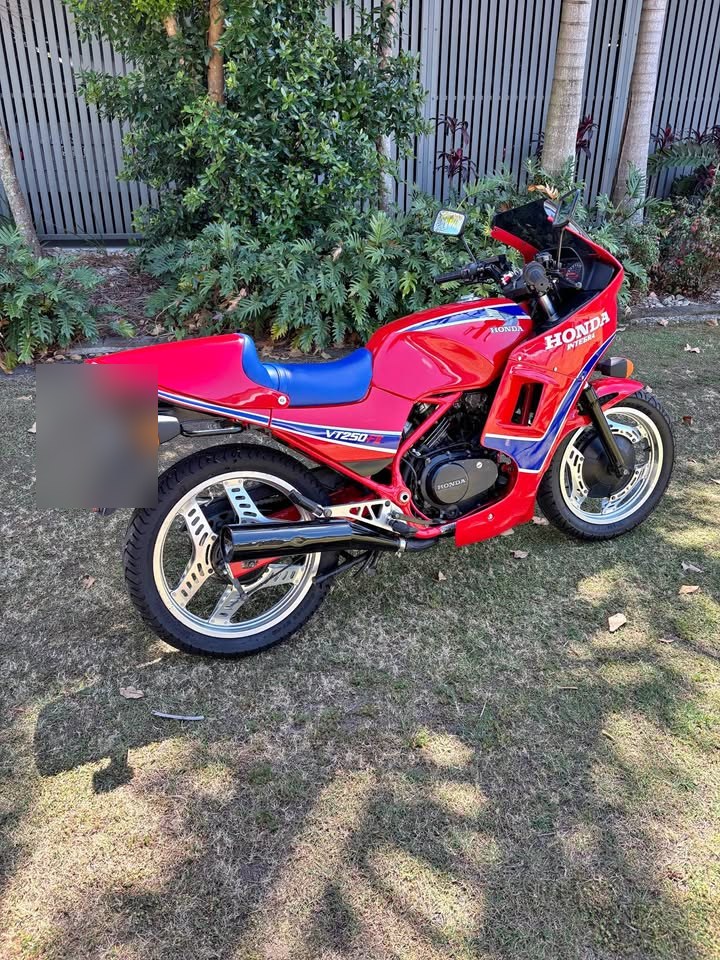
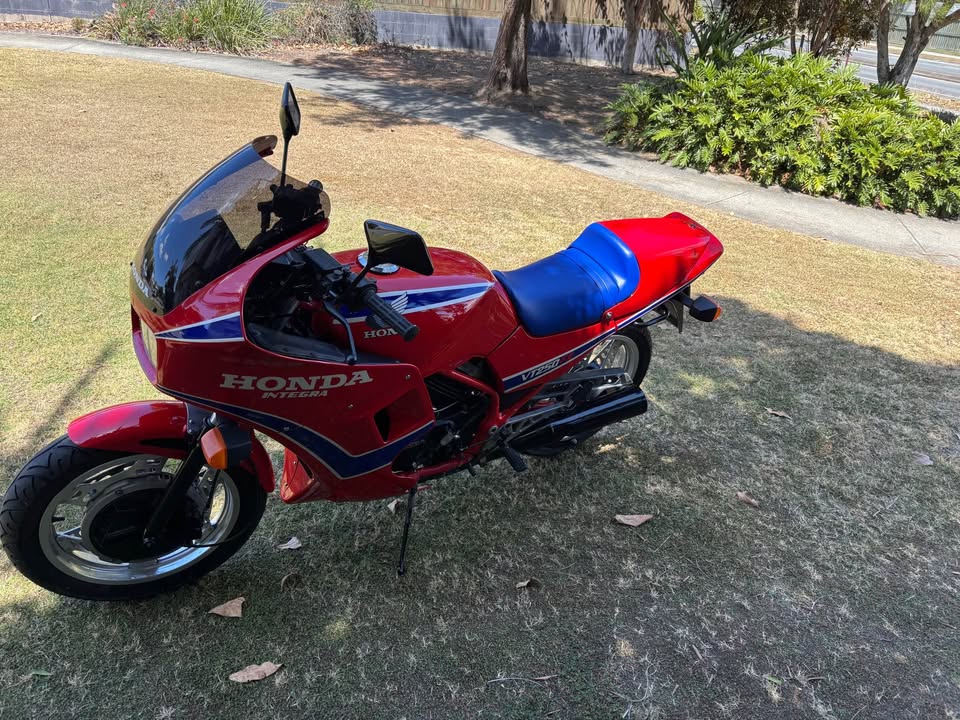
1983 Honda VT250F Integra, red/blue, right side
12,500rpm
Red zone starts
11,000rpm
Peak power (35 PS)
~7,300rpm
At 100 km/h, 6th
~160km/h
Claimed top speed

Highway revs & the ceiling

01 / GEARING

Six speeds, chain final drive, primary reduction 2.821, final 3.214 (14/45), 110/80-18 rear. That gearing puts the engine at ~7,300 rpm at 100 km/h in top gear and ~8,100 rpm at 110 km/h — roughly 58–65% of redline just sitting at the speed limit. It's a 250 that lives high in the tacho, which is normal for this engine and exactly why it feels busy on the highway compared with a 500.

Speed6th gear5th gear% of 12,500 redline (6th)
60 km/h4,4004,900
80 km/h5,9006,500
100 km/h7,3308,160
110 km/h8,0608,970
120 km/h8,8009,790
Top speed (claimed)~11,600—
Red zone 12,500 · peak power 11,000 · peak torque 10,000

RPM figures are calculated from the factory ratios and tyre circumference, not from a tachometer reading. Real numbers will drift a couple of hundred rpm with sprocket changes and tyre wear.

12,500
Red zone begins

Honda built this engine to beat two-strokes at their own game. Peak power lands at 11,000 rpm and the tacho keeps going into a red zone at 12,500. Period road testers wound them to nearly 14,000 rpm and reported no vibration — the 90° V layout cancels primary imbalance.

In top gear that puts the theoretical gearing limit at 171 km/h at 12,500; drag runs out around 160 km/h first, so on a real road you never reach redline in 6th. You will in 3rd (111 km/h at redline) and 4th (133 km/h).

What that means day to day

80 km/h in 6th is 5,900 rpm — below the torque peak, so roll-on is flat and it wants a downshift. The happy zone is 8,000–12,000. This is not a lazy highway bike; it's a small-capacity sport bike that happens to be legal to learn on.

Specification

02 / FACTORY FIGURES

Engine

Type4-stroke, 90° V-twin, DOHC, 4 valves/cyl
Capacity248 cc
Bore × stroke60.0 × 44.0 mm
Compression11.0:1
CoolingLiquid
Carburettors2 × 32 mm Keihin CV
Max power25.5 kW / 35 PS @ 11,000 rpm
Max torque21.5 Nm @ 10,000 rpm

Driveline

Gearbox6-speed
ClutchHydraulic, wet multiplate
Primary reduction2.821
Final driveChain 520, 14T / 45T (3.214)
Ratios 1–62.562 / 1.850 / 1.478 / 1.240 / 1.074 / 0.965

Chassis

FrameSteel double cradle, round-section tube
Front suspension37 mm telescopic fork
Rear suspensionSingle shock, box-section swingarm
Front brakeSingle inboard ventilated disc, 2-piston
Rear brakeDrum
WheelsComstar, tubeless
Tyres100/90-16 front · 110/80-18 rear

Dimensions

Wheelbase1,385 mm
Seat height780 mm
Dry weight152 kg (Integra, full fairing)
Fuel12 L
Top speed (claimed)160 km/h
Licence class (QLD)LAM-eligible — see note below

QLD LAM scheme: an RE licence covers production motorcycles up to 250 mL (almost any model) except the Suzuki RGV250, Kawasaki KR250/KR-1/KR1s, Honda NSR250, Yamaha TZR250 and Aprilia RS250, which exceed the power-to-weight limit. Bikes from 251 to 660 mL must appear on the approved list, and no LAM bike may be modified. The VT250F is 248 mL and not on the 250 mL exclusion list, so it should be LAM-legal unmodified — still confirm the individual bike with TMR's registration check before you buy.

What breaks

03 / OWNER REPORTS

These are the failures owners and workshop threads actually report on the VT250F/MC08 family — not generic old-bike warnings. Check them in this order when you inspect.

Deal-breaker
01

Regulator / rectifier cooks itself

Mounted behind the engine, in the hottest, least-ventilated spot on the bike. They overheat, stop regulating, then either boil the battery (overcharge) or stop charging. On a 40-year-old VT this is the single most common electrical failure.

TestVoltmeter across the battery: 13.5–14.8 V at 5,000 rpm. Above 15 V means the R/R is dead — walk or budget $100–200 for a MOSFET replacement.
Deal-breaker
02

Cam chain & tensioner rattle

The tensioner is the weak point of the whole VT family. It goes soft with age, the chain slaps, and if it's ignored long enough the timing jumps. Parts are still gettable; labour isn't cheap because it's a V-twin with two heads.

ListenRattle from the top end at idle and just off idle, hot. Should be silent. Chains and tensioners are service items, not terminal — but price them in.
Costly
03

Exhaust collector rusts through

The collector box under the engine rots from the inside out. Genuine replacements are gone; used ones are usually halfway there too. A holed collector makes it loud, lean and unrideable in traffic.

LookUnder the engine with a torch, cold. Any flaking, bubbling chrome or a sooty stain at a seam means it's on the way out.
Costly
04

Carb diaphragms & airbox

CV diaphragms perish and there is no reliable supply of new ones. The carbs are awkward to remove and refit, and the airbox is famously tight in the frame. A bike that's been sitting is the worst case.

TestSnap the throttle from idle: it should pick up cleanly and return to a stable idle. Any hanging revs or a 3,000 rpm ceiling means torn diaphragms or blocked pilots.
Safety
05

Inboard front disc

Rare 1980s Honda system: the disc sits inside the wheel and the pads grip it from within. It works and it's easy to service — but pads and discs are unique to these years and the feel is wooden compared with a modern disc.

TestFirm lever, no pulsing, no scoring visible through the wheel. Check the disc isn't warped — a pulsing lever at low speed means replacement.
Safety
06

Vacuum petcock & fuel tap

The fuel tap is vacuum-operated off one carb. The rubber diaphragm perishes with age and ethanol fuel; symptoms range from fuel starvation at high rpm to fuel leaking past the tap into the engine when parked.

LookPull the vacuum hose and sniff for fuel. A tap that drips with the engine off will eventually hydraulic-lock a cylinder.
Age
07

Bottom-end bearings when run hot

The engine holds a lot of heat and owners report crankshaft bearing damage when oil level or quality is neglected. Not a design defect so much as a consequence of 12,000 rpm and 1980s oil.

ListenDeep knock under load, low oil pressure light flickering at idle, metallic sheen in the oil. Any of those is a rebuild, not a repair.
Wear
08

Swingarm bushes & collars

Bushes and collars wear and the back end starts to move. Cheap parts, fiddly job, and it's often the reason an old one feels vague in corners.

TestBike on the centrestand, grab the rear wheel and try to rock it side to side. Any play is bushes or wheel bearings.
Reality
09

Parts scarcity, and tyres

Plastics, trim and switchgear are long discontinued — used Japanese stock via Webike is the main channel. The 16-inch front and 18-inch rear sizes are getting thin on the ground in Australia too.

PlanBefore you buy, price a front tyre in 100/90-16 locally. If that's hard, everything else will be too.
This particular bike

04 / THE LISTING

Red flags in the ad itself

  • It isn't a VTX. Whoever wrote the title got the model wrong. Not sinister — but it means the seller may not know the bike, so assume nothing in the description has been verified.
  • "Driven 1,234 km" — that comes from the listing header, and the seller also says a new dash and speedo cluster was fitted. A replacement cluster resets the odometer, so the number is meaningless. Treat the mileage as unknown.
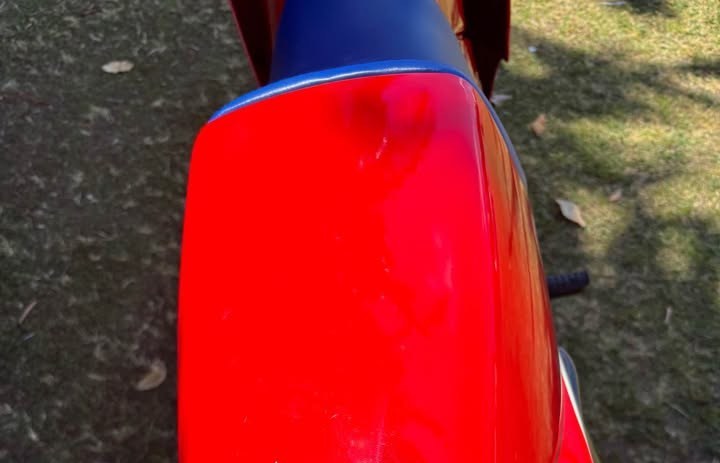
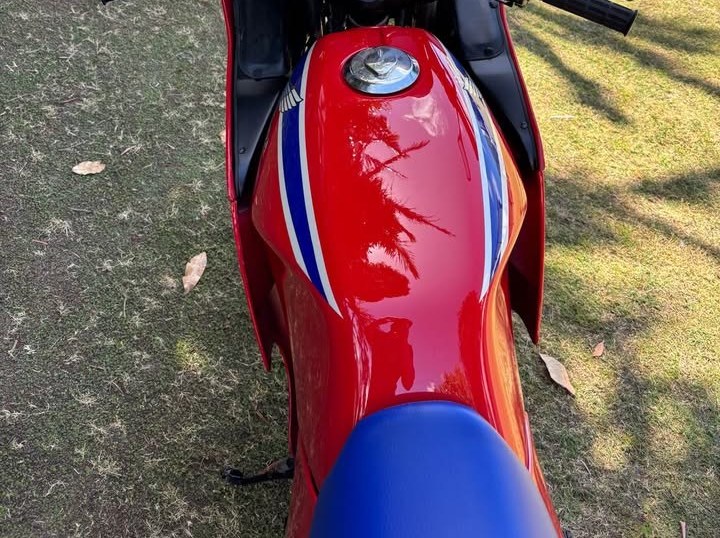
  • "New paint" — the best and worst line in the ad. It looks sharp in the photos, but fresh paint hides dropped-bike repairs, cracked fairing mounts and filled tank dents. Inspect the frame, steering stops and fairing brackets, not the panels.
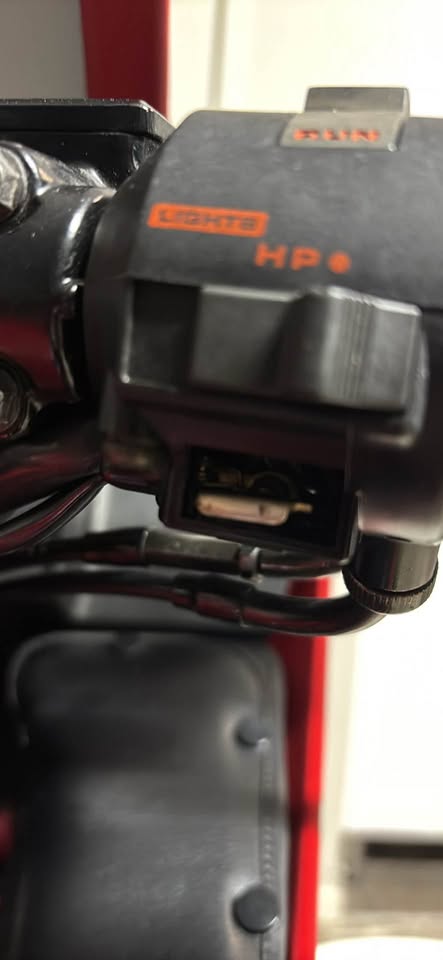
  • Broken starter switch + dead headlight — both are electrical, both are on the same switchgear and loom. Could be a five-dollar connector, could be a butchered harness. Assume the worst and check.
  • Sat for years — the seller says it started first go after sitting. That's a good sign for compression, but sitting is what kills carb diaphragms, coolant hoses, brake fluid and fork seals.

Seller's description (verbatim)

VT250f2 bike is in running condition. It has been sitting for a few years now, it started first go on the weekend. Work completed: New paint New dash and Speedo cluster New rear pads Changed the oil last weekend and a new filter Carbs reconditioned by Mr Carbs in Sydney — they are like new New rear tyre 2 years ago, should still be in date Rear cowl still has the original lock What needs work: The plastic starter switch has broken off — I do have a replacement Front headlight is not working, I suspect a dry connection as it works if I wiggle the connection — Seller, Brisbane QLD, AU$2,200, listed a week ago

Inspection order — 40 minutes

  • 1. Cold start. Insist the engine is stone cold when you arrive. It should fire within a couple of seconds and idle evenly on both cylinders — the seller has a replacement starter switch, so check whether the button works or has to be bridged.
  • 2. Charging. Multimeter on the battery at 5,000 rpm. 13.5–14.8 V. This one test saves you the most common failure.
  • 3. Cam chain. Listen hot at idle. Rattle = money off.
  • 4. Second gear. Hold it at 9,000+ rpm in 2nd and 3rd under load. A jumping or slipping gear is a gearbox-out job.
  • 5. Brakes and tyres. Lever should be firm with no pulsing; check the inboard disc isn't scored and the pads have meat. Read the DOT date on both tyres — "two years old" is fine, ten is not.
  • 6. Paperwork. QLD rego status, RWC, and whether it's ever been written off. A $2,200 classic with no rego is a project, not a bike.

How you'd sit on it — 187 cm

05 / RIDER FIT

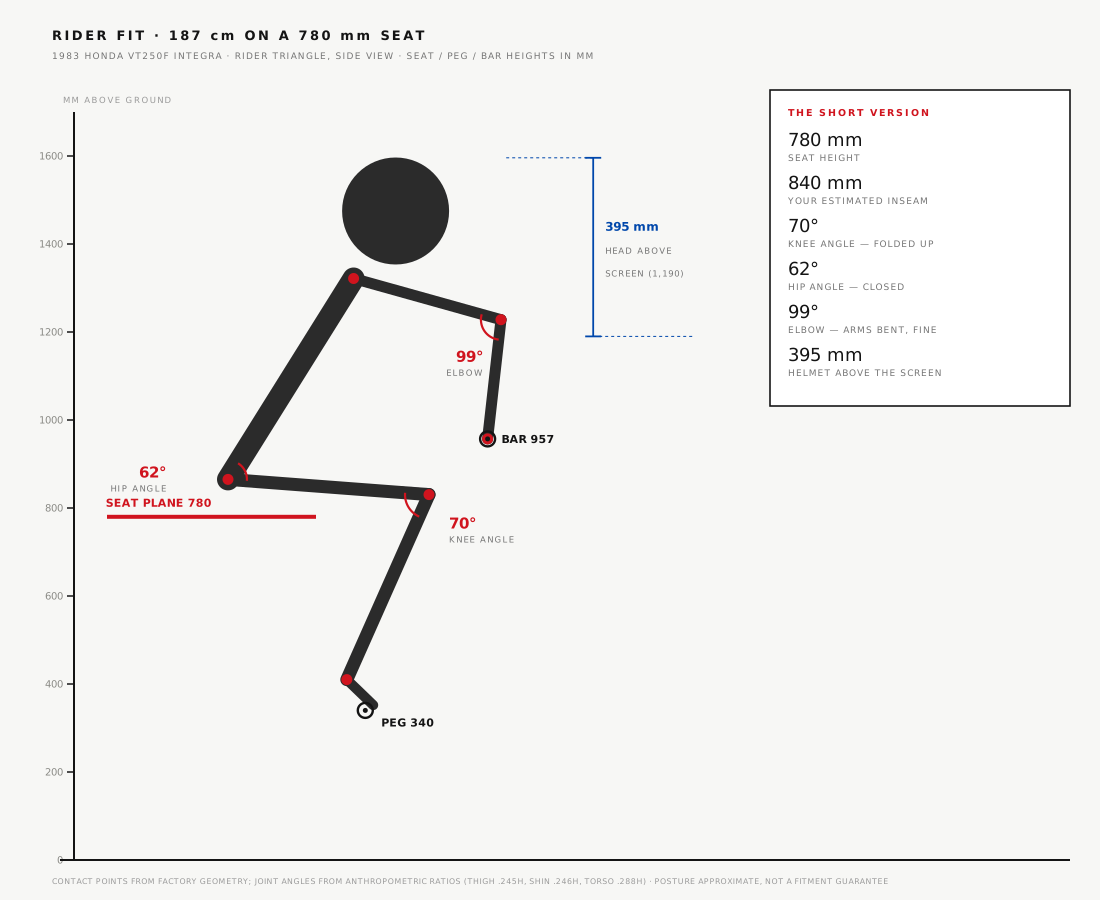
Drawn to the bike's real contact points: seat 780 mm, pegs 340 mm, bars about 957 mm above the ground, 1,385 mm wheelbase. Your joint angles are calculated from standard anthropometric ratios for a 1,870 mm rider — thigh 0.245×height, shin 0.246×height, torso 0.288×height — so treat the posture as a good approximation rather than a measurement of you.

Rider triangle diagram: 187 cm rider on a 780 mm seat
Good news
A

Feet flat on the ground

A 1,870 mm rider carries roughly an 840 mm inseam. The seat is 780 mm, so both feet go flat with knee bend to spare at every set of lights. On a 780 mm seat you are not tip-toeing — that is the one thing tall riders usually worry about on small bikes, and it's a non-issue here.

The catch
B

Knees folded to 70°

Seat to peg is short, and the pegs sit high and rearward. That gives a knee angle around 70° and a hip angle of 62° — noticeably tighter than the 95–110° that touring ergonomics aim for. It's fine for a 20-minute blast; at an hour your hips and knees will complain before your backside does.

Expect this
C

Your head sits above the fairing

The screen tops out at 1,190 mm; your helmet will be about 1,585 mm — roughly 395 mm above it. The Integra fairing protects your chest and hands, not your head. At 110 km/h you are the barn door, and the 35 PS engine has to push it.

Interactive
Walk around the bike in 3D — and drag your height from 160 to 200 cm
Open the 3D fit model →

Practical consequences: mirrors sit below your eyeline so you look over them (no blocked view); your knees will grip the tank hard, which is good for control; and the 32° forward lean with a 99° elbow is comfortable — the arms are the least of your problems. If you buy it, plan a stretch stop every 45–60 minutes.

Verdict

06 / MONEY

Mechanically this is a genuinely interesting little bike — a 90° V-twin that revs to 12,500 with a hydraulic clutch, single-shock rear and Comstar wheels, in 1983. As a learner-legal classic that isn't a CB250, it has more character than anything else in the price bracket.

The catch is the shape of the ownership, not the bike. It's a 43-year-old, low-volume, fully-faired Honda with a weak charging system and discontinued plastics. Expect to spend the first few months sorting electrics and consumables, and shop from Japan for anything cosmetic.

At $2,200 a running, registered, cosmetically tidy Integra is fair money. At $2,200 needing a regulator, tyres and a cam chain, it's a $3,000 bike pretending to be a $2,200 one. The difference is an inspection and a voltmeter.

Likely first-year costsEst.
Regulator / rectifier (if dead)$100–200
Cam chain + tensioner$250–500
Tyres, both ends$350–500
Brake fluid, coolant, fork seals$150–300
Battery$90–150
Worst case on top of purchase~$1,400

Gallery — the actual bike

07 / LISTING PHOTOS
VT250F Integra rear three-quarter
Rear three-quarter — 2-into-2 exhaust, white Comstars
VT250F Integra right side
Integra full fairing, rectangular headlight
VT250F Integra tail cowl
Tail cowl — original lock
VT250F Integra tank and bars from above
Tank and bars — new paint
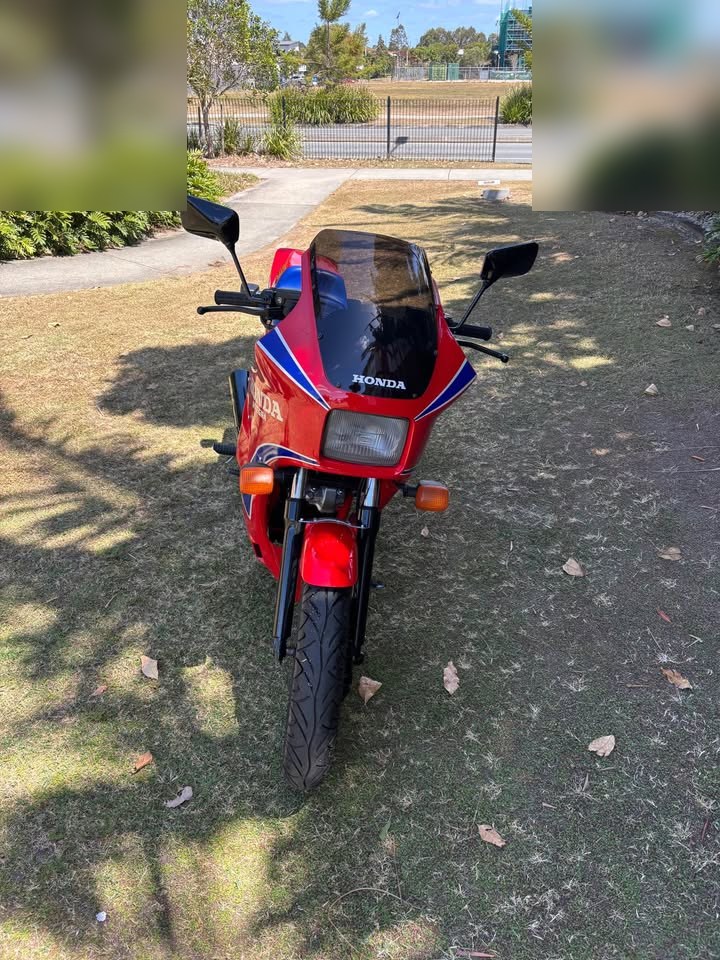
VT250F Integra front on
Front on — clip-ons, square light
VT250F Integra switchgear close-up
Switchgear — broken starter switch

Sources

08 / REFERENCES

Prepared 26 October 2026. RPM figures are derived from published gear ratios; everything else is sourced above. This is research, not a mechanical inspection — get the bike looked at before money changes hands.